Decide a flop in ten seconds
Two boards, eight players, a pot-sized bet coming at you. You do not have time to count outs on both boards and average them. You have time to name a colour. This is how we do it at the table, and it is what the trainer scores you against.
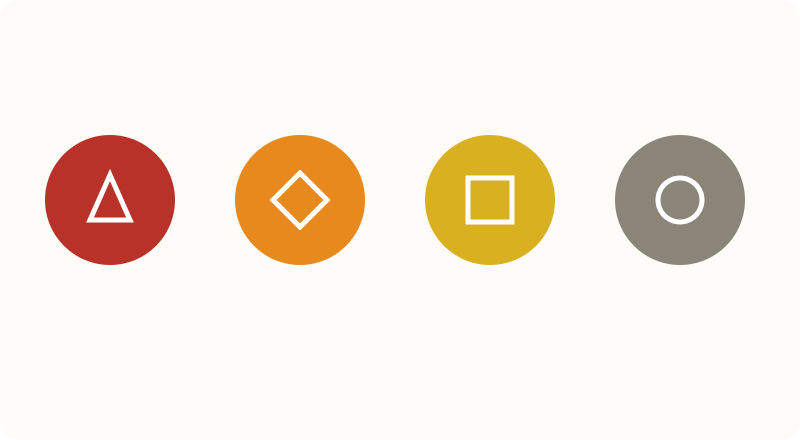
Step one: give each board a colour
Look at one board, ask what you hold on it, name the colour. Then the other board. Two colours, then a rule.
the nuts · a 13-out wrap · second nuts · a non-nut full house
an 8 or 9 out draw to the nuts · a non-nut flush · a hand only two or three hands beat
a set that is not top set · a non-nut straight · a small draw to the nuts (4 or 5 outs)
two pair · one pair · nothing · any draw that is not to the nuts
Reading a wrap without counting
- Three of your cards in a row touching the board from above: a wrap, red. J♠T♥9♦ on 8♣7♠2♦
- Two of them: an open-ender, 8 outs, orange.
- A gap in the middle: yellow.
- Your cards sit below the board: yellow at best. When you hit, somebody often holds the high end.
- A paired board, or three of a suit when you do not hold the ace of it: your straight draw is grey.
Step two: nobody has bet
Four hole cards
- Red or orange on either board: bet about three quarters of the pot.
- Yellow on both boards: bet.
- Anything else: check.
Five hole cards
- Red on either board: bet.
- Orange on one board and yellow or orange on the other: bet.
- A straight on both boards: bet.
- Anything else: check.
Why the difference? With five cards everybody has more, so the bar is higher. In our simulations the same bet that earns with four cards loses with five unless the hand is one step better.
The bet is the same from every seat, blinds included. It earns because it is the first bet: the player with nothing calls it cheaply on the flop and folds to the turn bet, and the player with a real hand pays you. What you do not do from the blinds is bet a merely decent hand into seven players. A set with nothing on the other board is a check from the small blind. That is the one rule everybody hates and everybody is wrong about.
The bet is not "I have the best hand right now". It is "I will have a strong hand on the turn more often than the people calling me". Those are different questions, and the second one is the one that pays.
Step three: someone has bet
This is most flops in a lively game. The question changes. It is no longer "does the table give me the price". It is "do I hold a real hand".
- A safe nuts on one board (nut flush, nut full house, quads) and strength on the other: raise the pot. This is the only hand that raises.
- Red on a board: call. Do not raise. Let the bettor keep betting into you.
- An 8 or 9 out draw to the nuts on one board: call once. On the turn without improvement, facing another bet, fold.
- Everything else: fold. Two pair, a middle set, trips on a paired board, a non-nut straight, a non-nut flush. Even when the pot odds say call.
Why fold hands the pot odds like? Because the pot odds are computed for one board. You pay the full bet and you can usually win only half. A nut flush draw on one board with nothing on the other, facing a bet and three callers, looks like five to one. It is closer to two to one once you remember that hitting your flush wins half the pot, and the half you win is shared with the people who also put money in. It is a fold, and it is the least intuitive fold in the game.
Step four: bet and raise in front of you
Assume the worst. Count only what beats the nuts: a safe nuts is 100, a nut straight is 50 because it is so often shared, otherwise your nut outs times four on the flop, times two on the turn, zero on the river. Average the two boards, compare with the price (a pot bet needs 33, two thirds needs 30, half needs 25). Call or fold. Never raise without a safe nuts.
If you bet first and got raised: a safe nuts calls. Everything else folds. You lost one bet, not a stack.
The turn, when your flop bet was called
You hold one of these: the nuts on a board, an 8+ out nut draw, top set or top two pair on a board that few hands beat. Bet the pot. Whoever called the flop with nothing folds now, and whoever calls is paying for a draw against a made hand. None of those? Check. Do not fire the second bullet out of habit.
What this is not
It is not solver output and it does not claim to be unexploitable. It is a method for a live table, tested in our engine against three table types (normal, loose, aggressive) with four and with five cards, and against the decisions in the one published book on the game. It beat the alternatives we could test, including betting smaller, betting bigger and calling by price. You can run the same tests: the engine is ours and the drills come from it.
THE 30-DAY COURSE
A plan for your next game.
One lesson. One drill set. A little more clarity at the table.